
Greenhouses with Photovoltaic Glass
Solar energy, agriculture, and local economy on the same land area
A greenhouse with photovoltaic glass is not just a modern greenhouse.
It is a smarter alternative to conventional photovoltaic farms.
A conventional photovoltaic farm produces energy, but it occupies land. In many cases, that land no longer produces food, no longer supports agricultural activity, and creates relatively few permanent jobs after construction is completed.
A greenhouse with photovoltaic glass can produce electricity at a relevant scale while keeping the land in agricultural production.
The same land area can generate:
Instead of choosing between energy and agriculture, we can build infrastructure that combines them.
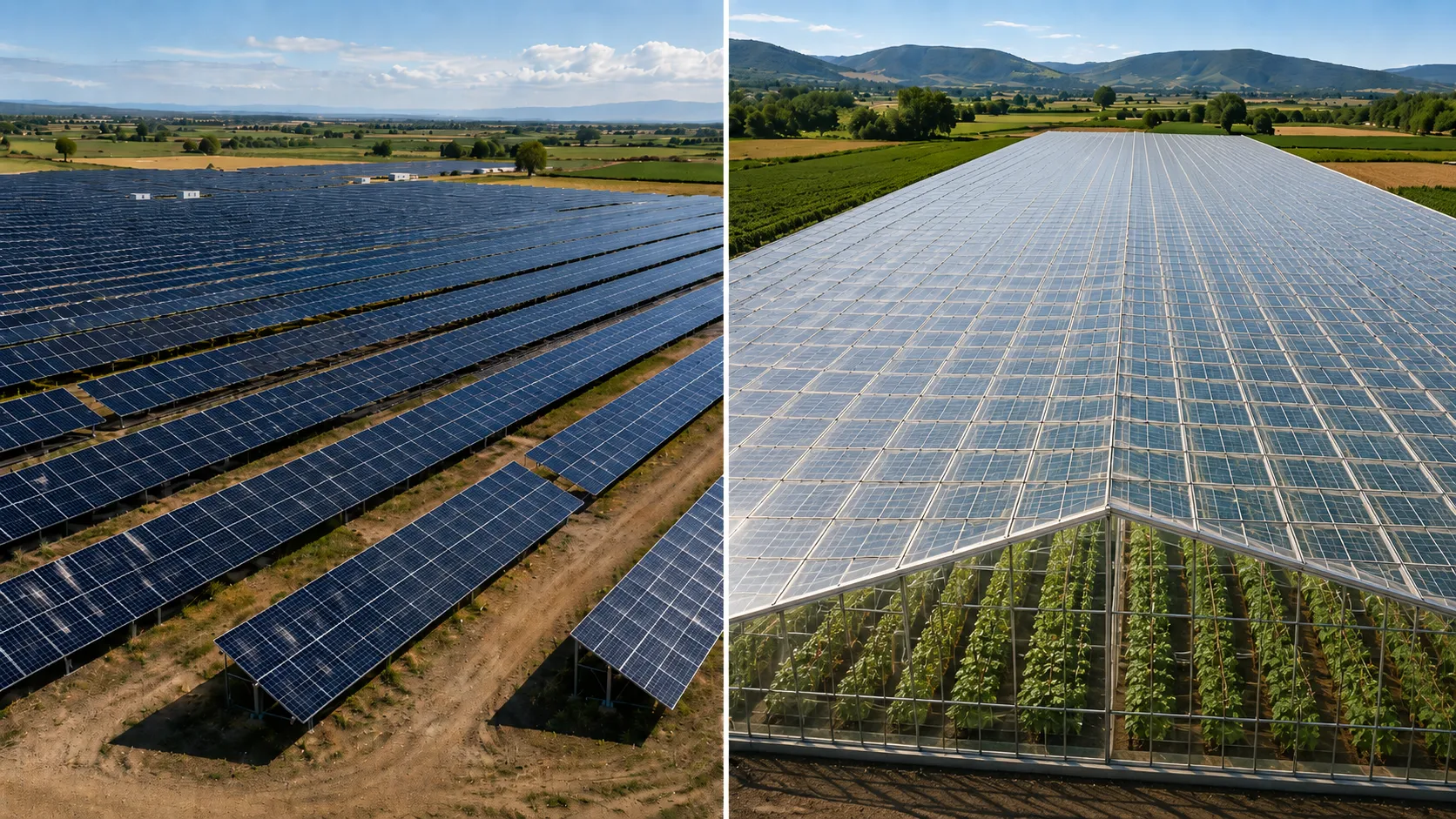
An alternative to conventional photovoltaic farms
Conventional photovoltaic farms play an important role in the energy transition, but they raise an important question: how much agricultural land are we willing to turn into land occupied only by PV installations?
Greenhouses with photovoltaic glass propose a different direction.
Instead of installing PV modules on open agricultural land, we can turn the structure of a greenhouse into an integrated solar power plant.
The difference is essential:
A conventional PV farm produces energy.
A photovoltaic greenhouse produces energy while preserving the agricultural function of the land.
The main profit may come from electricity production, but agriculture adds an important additional value: the land is not economically abandoned. It continues to produce, create activity, and support the local community.
Output close to a PV farm, without sacrificing the land
In a well-designed configuration, a greenhouse with photovoltaic glass can produce roughly 70–90% of the energy generated by a comparable conventional photovoltaic farm.
The percentage depends on the project:
Even if each square meter of semi-transparent photovoltaic glass may produce less than an opaque PV module with optimal orientation, the greenhouse can compensate by using more sun-exposed surfaces.
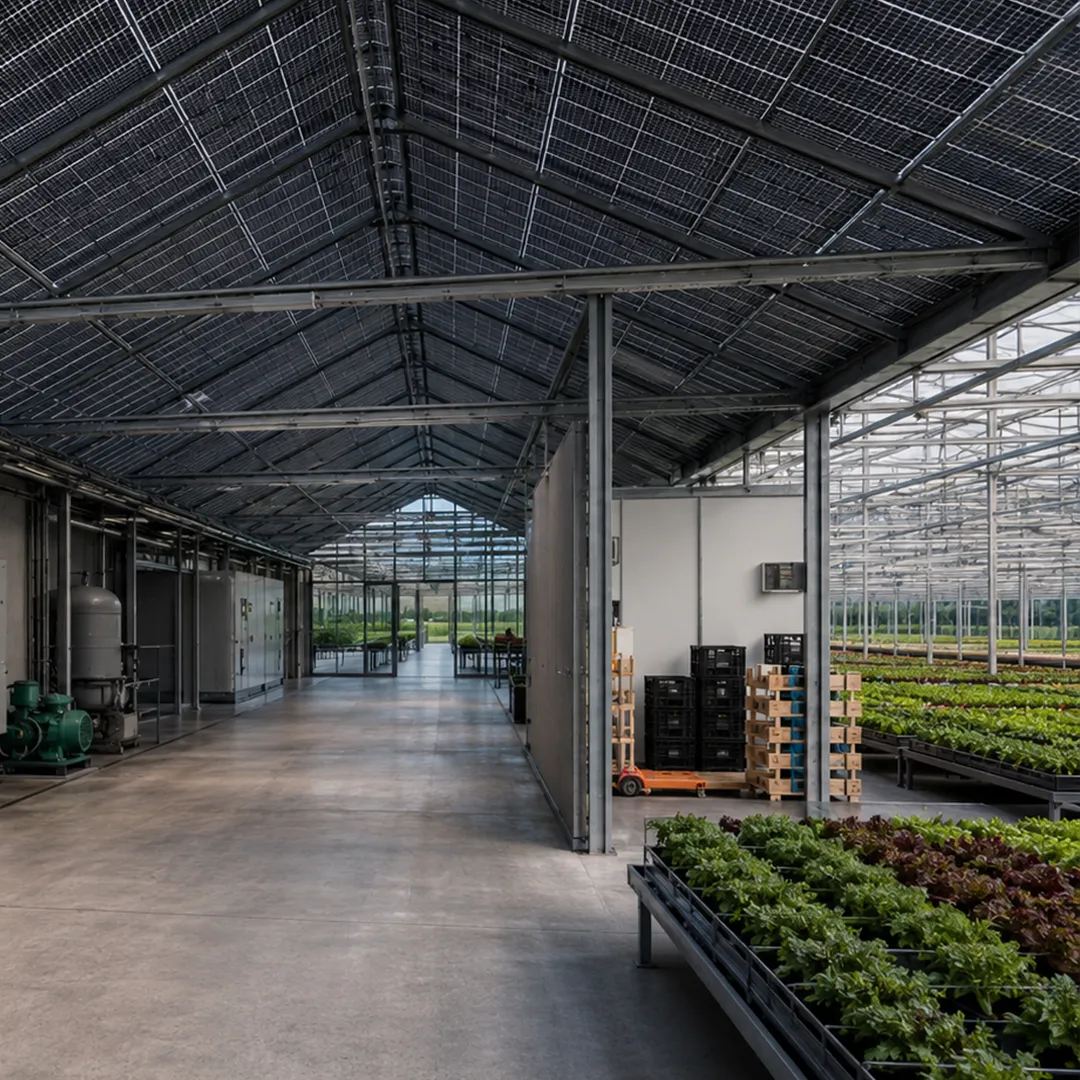
A greenhouse does not have just one flat surface. It has inclined roofs, gables, and walls facing south, east, and west.
As a result, a photovoltaic greenhouse can have a very large active surface compared with its ground footprint.
The result is a major difference compared with a conventional PV farm:
The PV farm produces energy and occupies land.
The photovoltaic greenhouse produces energy while keeping the land in agricultural production.
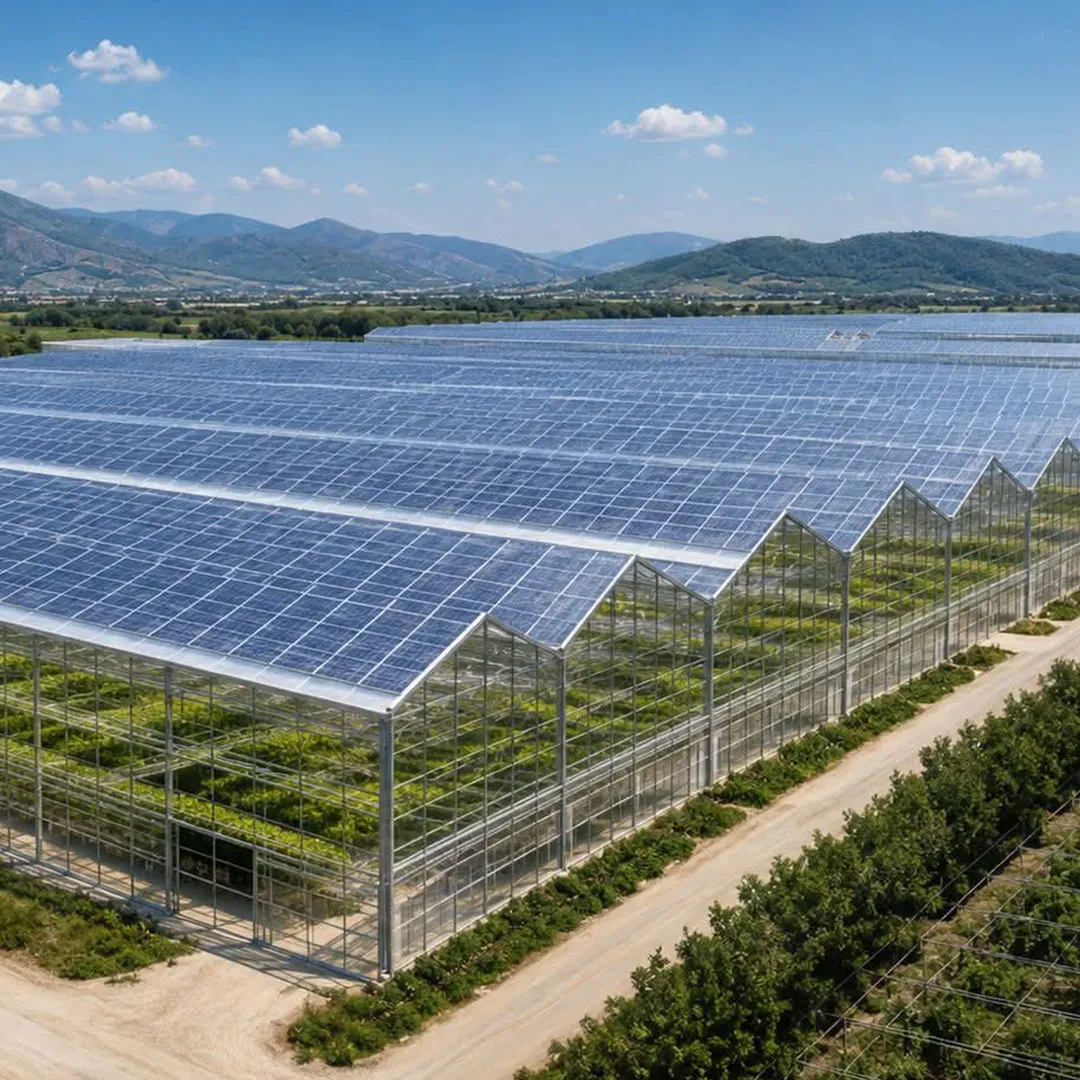
The greenhouse uses more than just the land beneath it
A conventional photovoltaic farm is mainly designed around the ground area it occupies. PV modules are installed in rows, with spacing between them to avoid shading and to allow access, maintenance, and optimal inclination.
A greenhouse is a three-dimensional structure.
It can use:
By integrating photovoltaic glass, these surfaces can become productive energy-generating areas.
In the morning, east-facing walls can produce energy. During the day, the roof and south-facing areas can take over the main production. In the afternoon, west-facing walls can continue production.
This distribution can be more useful than a short production peak at noon, especially when the energy is consumed locally or delivered at different times of the day.
The greenhouse does not use only the land. It uses the built volume.
Photovoltaic glass with transparency adapted to each area
Photovoltaic glass can be produced with different levels of transparency, depending on the light requirements of the crop, the orientation of the surface, and the energy objective of the project.
Not all areas of a greenhouse need to be treated the same way.
In areas dedicated to crops that need more light, photovoltaic glass with higher transparency can be used.
In areas where natural light is not critical, photovoltaic glass with lower transparency and higher electricity production can be used.
Such areas may include:
On the northern side, where solar contribution is lower, ordinary glass or other conventional transparent materials can be used, because photovoltaic production would be lower and the investment would be harder to justify.
This approach makes it possible to maximize energy production without unnecessarily affecting the main crops.
In practice, the greenhouse can be intelligently divided:
In this way, each area of the greenhouse receives the right material: transparency for the crop, energy production for secondary areas, and optimized cost for areas with low solar contribution.
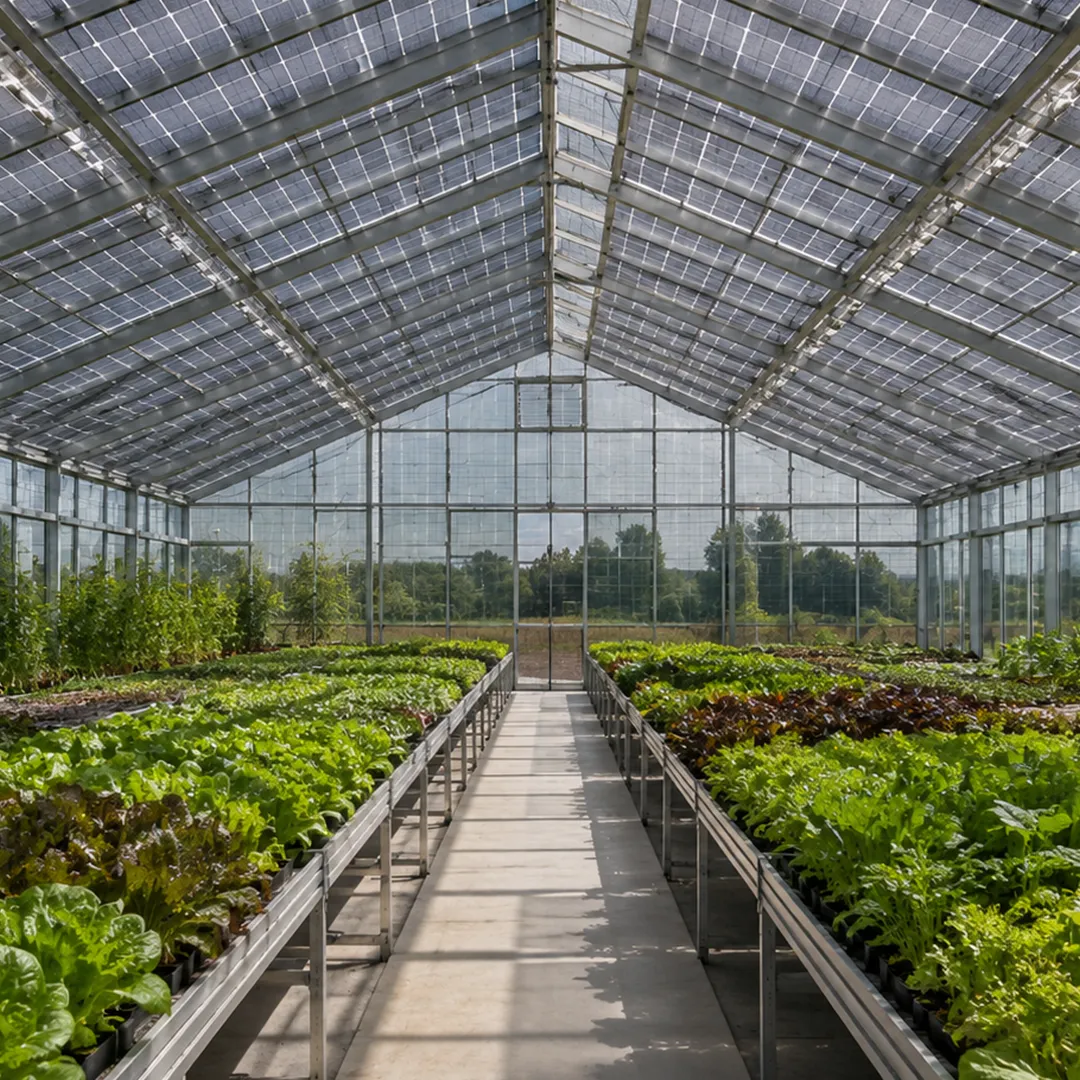
We do not cover the greenhouse randomly. We design it intelligently.
In a greenhouse, the optimal solution is not to use the same transparency everywhere.
Plants need light. Each crop has its own tolerance threshold for shading. That is why photovoltaic glass must be integrated selectively, depending on:
The key is not to put as much PV as possible on every surface, but to place PV where it creates the highest value.
Higher cost, but faster payback
A greenhouse with photovoltaic glass has a higher initial cost than a greenhouse built with conventional transparent materials.
The difference is that photovoltaic glass is not just a covering material. It is a material that produces energy.
Ordinary glass protects the crop.
Photovoltaic glass protects the crop and produces electricity.
The initial cost is higher, but the investment has its own recovery source: the energy produced.
Payback can come from:
In other words, you are not just buying glass. You are buying a surface that produces energy for years.
The main profit comes from electricity production
In a photovoltaic greenhouse project, the main profit can come from electricity production, not necessarily from agriculture.
This is the positioning difference compared with a conventional greenhouse.
A photovoltaic greenhouse can be seen as a solar power plant integrated into agricultural infrastructure.
The electricity produced can be:
Agriculture does not have to be the only source of profit. It becomes the additional advantage that makes the project better than a conventional PV farm.
A PV farm produces energy, and that is all.
A photovoltaic greenhouse produces energy while keeping the land economically alive.
Direct self-consumption: the cheapest kWh
The cheapest kWh is the one produced and consumed locally.
In a greenhouse with photovoltaic glass, the energy produced can be used directly for the farm’s own consumption:
This energy no longer needs to be purchased from the supplier.
It no longer includes transmission, distribution, and tax costs.
It does not depend on temporary offers.
It does not depend on special price intervals.
A cheap electricity offer from the grid can be useful as backup or as a complement, but the main advantage remains the energy produced directly by the greenhouse, where it is consumed.
The priority in such a system should be:
- 1local production;
- 2direct self-consumption;
- 3flexible loads operated during periods of solar production;
- 4grid supply only when necessary;
- 5using cheap grid electricity intervals as a secondary strategy.
Locally produced energy also makes agriculture more competitive
Even if the main profit of the project may come from electricity, local self-consumption also has an important agricultural effect: it can reduce production costs.
In a conventional greenhouse, energy is a cost.
The farmer pays for irrigation, ventilation, automation, pumps, sensors, local heating, humidification, climate control, or other auxiliary consumption.
In a greenhouse with photovoltaic glass, part of this energy can be produced by the greenhouse itself.
This can make the cultivated products more competitive compared with those grown in conventional greenhouses, because part of the energy cost is covered locally.
Every kWh produced and consumed in the greenhouse can help reduce the cost per kilogram, per crate, or per production cycle.
A conventional greenhouse produces food and consumes energy.
A photovoltaic greenhouse produces food and part of the energy needed to produce it.
Areas with higher PV production and useful local consumption
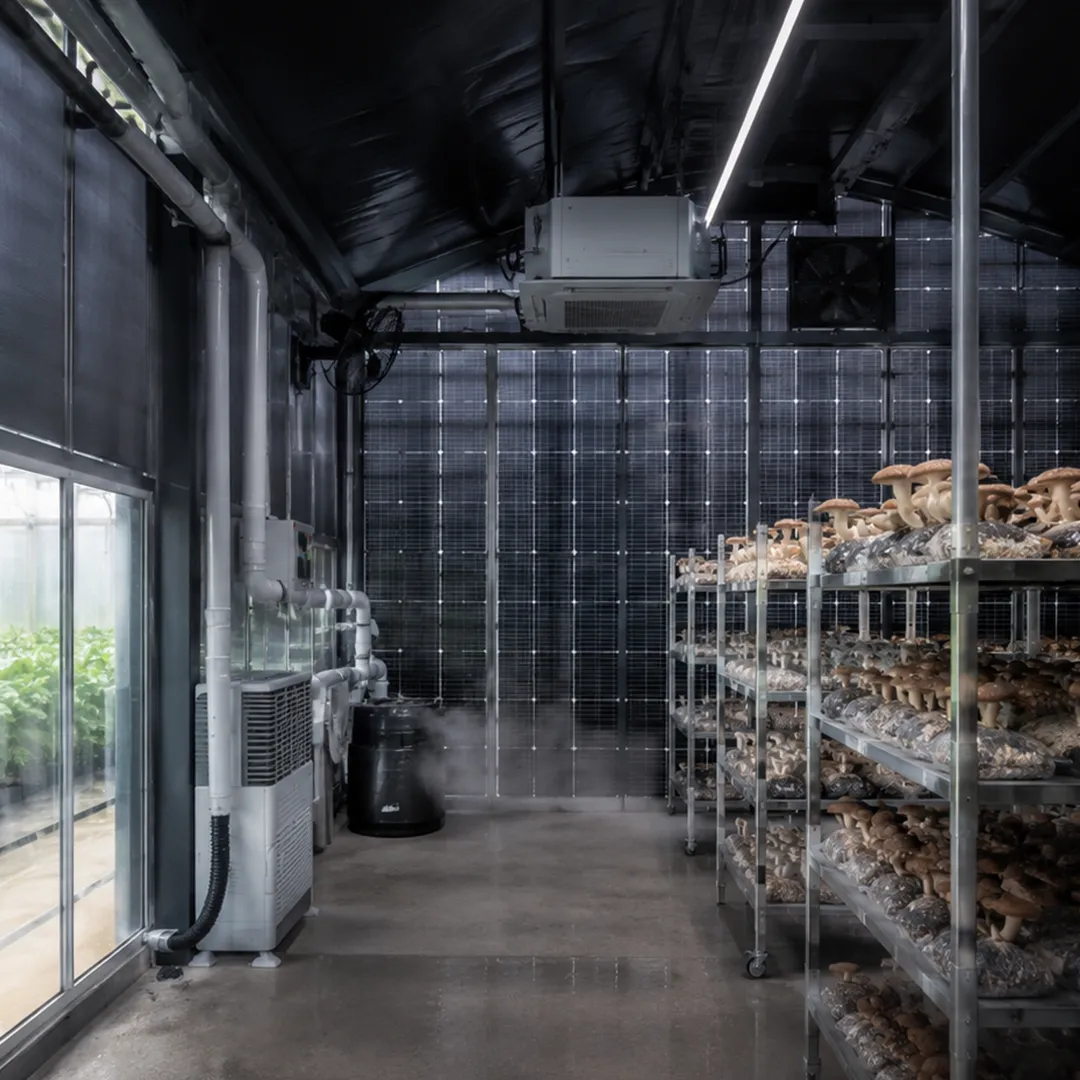
In certain areas of the greenhouse, where light for the main crops is not critical, photovoltaic glass with lower transparency can be used.
These areas produce more electricity.
The advantage is that this energy can be consumed locally, inside the greenhouse, by equipment that needs electricity exactly during hot or sunny periods.
For example:
Mushrooms are an interesting example. They can be grown in low-light areas or dedicated compartments, where photovoltaic glass can have lower transparency and higher electricity production.
These spaces may require controlled temperature, ventilation, humidification, and, in certain periods, air-conditioning cooling.
This is exactly where the advantage appears: the area that produces more electricity can locally consume part of this energy for the climate control required by the crop.
In this way, a surface with denser PV glass does not become a lost agricultural area, but an area with higher energy production and useful local consumption.
The energy produced can power fans, humidifiers, sensors, pumps, automation, and cooling systems, reducing dependence on electricity purchased from the grid.
Flexible consumption and cheap electricity from the grid
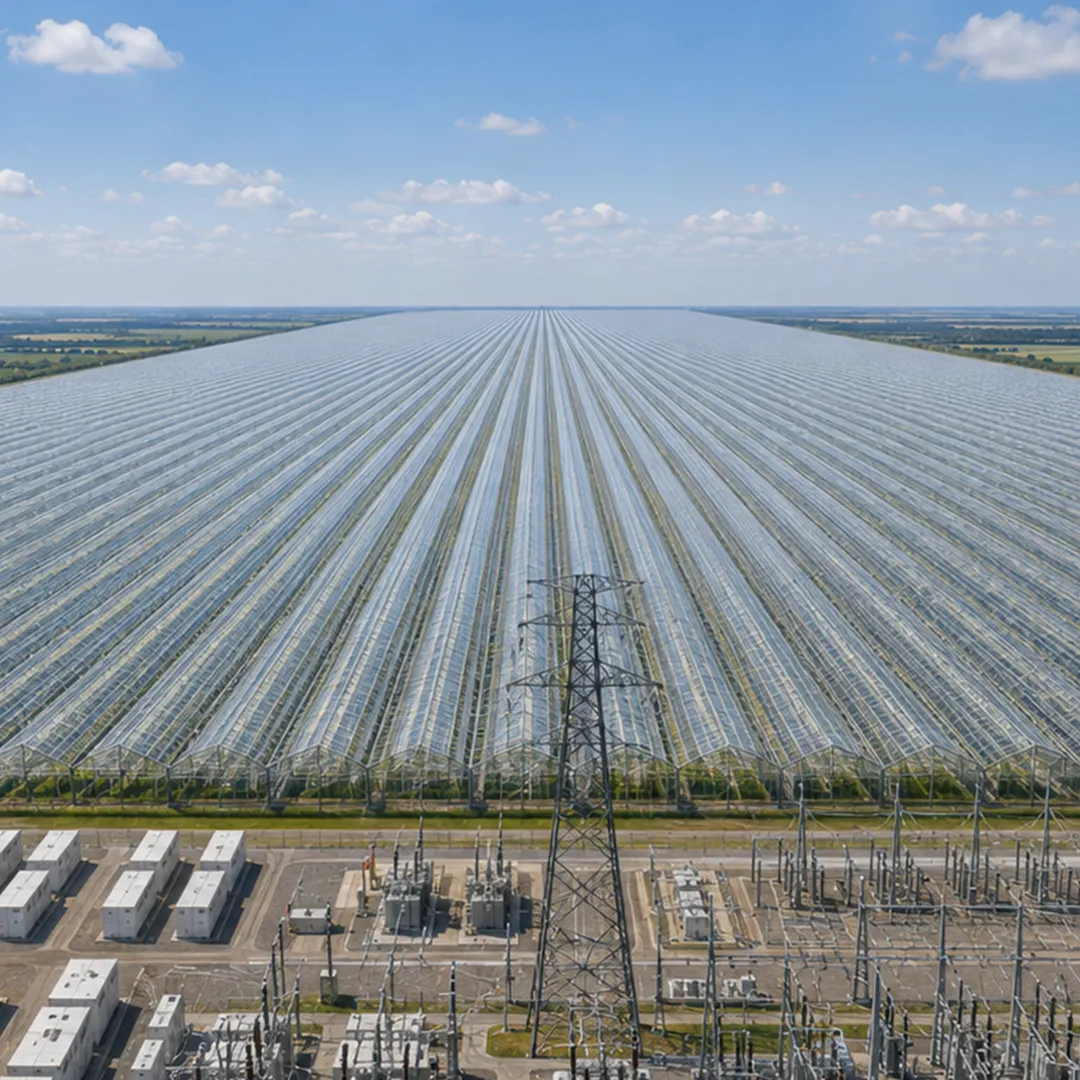
In addition to its own production, a greenhouse can also benefit from flexible consumption.
In an energy system with increasing amounts of solar and wind energy, there are periods when electricity from the grid is cheap or available in excess.
A greenhouse can adapt certain loads to these intervals:
This can bring an additional advantage.
However, cheap electricity from the grid is not the main argument. The main argument is the energy produced locally by the photovoltaic glass.
The grid remains useful as backup, as a complement, and for optimization.
It creates local economy, not just energy
A conventional photovoltaic park has an intense construction period, after which it becomes infrastructure with relatively low operation requirements.
After installation, the number of permanent jobs is limited.
A photovoltaic greenhouse can create long-term local economic activity.
It can support:
This means the land is not monetized only through kWh production. It becomes a local economic platform.
Energy remains the main source of profit, but agriculture adds social, economic, and political value.
Better social acceptance
Many communities look with hesitation at photovoltaic farms built on agricultural land.
The arguments are familiar:
A photovoltaic greenhouse has a much better story.
It produces energy, but also food.
It brings technology, but preserves agriculture.
It uses the sun, but does not abandon the land.
It creates income, but also local activity.
For this reason, a photovoltaic greenhouse can be more easily accepted than a conventional photovoltaic farm on agricultural land.
Problems of conventional PV farms on agricultural land
Conventional photovoltaic farms are useful for renewable energy production, but they can create tensions when placed on valuable agricultural land.
Under certain conditions, they can:
Not every PV farm produces these effects to the same extent. Everything depends on the project, the land, execution, and maintenance.
But the question remains legitimate: if we can produce energy without blocking agricultural land, why not choose that option?
Greenhouses with photovoltaic glass offer an alternative: they produce energy while keeping the land in the economic and agricultural circuit.
Do you live in an apartment?
Be smart and install our system that will bring you greater energy and financial independence!
What crops are suitable for greenhouses with photovoltaic glass?
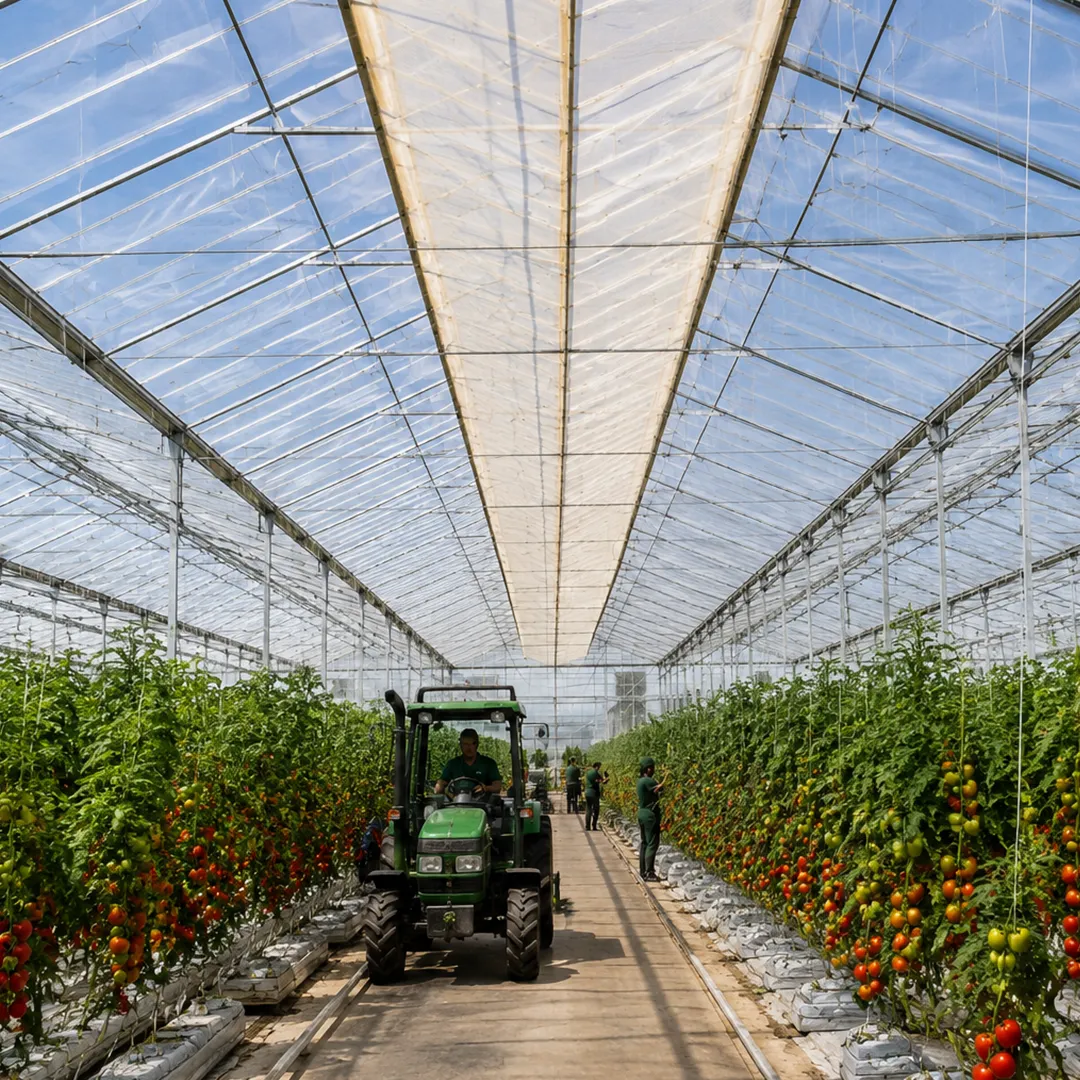
Greenhouses with photovoltaic glass can be adapted for several types of crops, depending on glass transparency, orientation, shading level, and light requirements.
Examples of suitable crops may include:
For crops that require constant maximum light, any reduction in radiation can affect production.
In these cases, the recommendation is to test on small areas, simulate light conditions, and choose a solution with high transparency or partial photovoltaic coverage.
What do studies say about agrivoltaics and photovoltaic greenhouses?
Recent research shows that agrivoltaic systems can allow the simultaneous production of food and energy, but the results depend on the crop, climate, module type, transparency, orientation, and shade distribution.
The conclusion is simple: a photovoltaic greenhouse is not a universal solution, but a solution that must be designed intelligently.
For the right crops, partial shading is not necessarily a problem. It can become an advantage: less heat stress, lower water consumption, a more stable microclimate, and locally produced energy.
Main benefits
1. High energy production
In well-designed configurations, a greenhouse with photovoltaic glass can produce roughly 70–90% of the energy of a comparable PV farm, without eliminating the agricultural function of the land.
2. Land kept in agricultural use
The land is not turned into an area occupied only by PV installations. It remains productive land.
3. Extended active surface
Roofs, south-facing, east-facing and west-facing walls, gables, and shaded areas can become active energy-generating surfaces.
4. Zone-adapted transparency
The greenhouse can have glass with different transparency levels: more light for crops, higher PV production for walkways, technical spaces, offices, gables, or areas where light is less critical.
5. Direct self-consumption
The energy can be used locally for irrigation, pumps, ventilation, humidification, climate control, sensors, and automation.
6. Revenue from energy
The main profit can come from electricity production, either through sale or self-consumption.
7. More competitive agricultural products
Locally produced energy can reduce operating costs and make cultivated products more competitive.
8. Local economy
The photovoltaic greenhouse can support jobs, agricultural production, local distribution, and permanent economic activity.
9. Better social acceptance
Compared with a conventional PV farm, a photovoltaic greenhouse has a stronger social argument: it produces energy while preserving agriculture.
10. Accelerated payback
The initial cost is higher than for conventional materials, but photovoltaic glass produces energy and helps recover the investment.
Where can it be used?
The solution is suitable for:
A new generation of solar infrastructure
Until now, many solar projects have been designed simply: land plus PV installations.
Greenhouses with photovoltaic glass propose a new generation of solar infrastructure:
land plus agriculture plus energy plus local economy.
It is not just a greenhouse.
It is not just a photovoltaic park.
It is a structure that combines both.
A photovoltaic greenhouse can produce energy almost like a conventional PV farm, but without leaving the land without agricultural function.
That is the difference.
Collaboration with greenhouse producers and installers
PhotoVoltaic Windows is looking for partners to develop pilot projects with photovoltaic greenhouses.
We do not want to replace greenhouse builders. We want to add a new option to their portfolio: semi-transparent photovoltaic glass for roofs, walls, gables, and shading areas.
We can collaborate with:
The goal is simple: to demonstrate that solar energy can be produced without taking land out of agricultural use.
If you produce, install, or operate greenhouses and want to test the integration of semi-transparent photovoltaic glass, we invite you to discuss with us.
We can talk at +40.720.729.025
or